Wednesday, June 1, 2011

Enhancing UF Membranes with Carbon Nanotubes

One of the most promising new frontiers in filtration technology involves infusing different membrane types with nanomaterials in order to improve performance or to pass along certain material attributes. Here we will look into one prominent example from recent years, the incorporation of carbon nanotubes (CNTs) into ultrafiltration membranes used in water treatment. We’ll also look at how our stirred cells have aided in this specialized membrane manufacturing process.

First off, what is there to gain by using CNT’s to manufacture water treatment membranes? While scientists have identified several potential advantages for CNT implementation, since the process is still in the R&D phase they have not necessarily been proven in all cases. One key possible benefit is that membranes made with these materials would be much stronger than traditional membranes, thus reducing instances of membrane breakage and fouling, two problems that contribute significantly to high maintenance costs in water treatment. Another unique advantage is that CNTs have antibacterial properties that may reduce biofilm formation and therefore prevent or limit biofouling. Lastly, the process of manufacturing ultrafiltration membranes with CNTs allows the producer to chemically modify the membrane surface which can further reduce fouling by tailoring the membrane for specific organic solutes.

As with standard membrane manufacturing processes, the stirred cell is an ideal piece of equipment for establishing the permeability of the test membranes. For this particular study on the effectiveness of polysulfone ultrafiltration membranes manufactured with CNTs, the cell (an HP4750 in this case) was set to perform dead-end filtration with ultrapure water at 38 bars of pressure (about 551 psi).
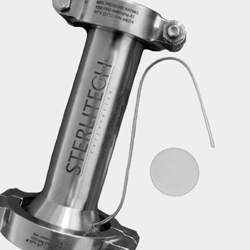
The HP4750 Stirred Cell
In order to determine permeability, the HP4750 was directly connected to the pressure regulator of the compressed air tank. Each membrane was compacted at 38 bars until the flow rate was stable (minimum of 30 minutes). Then the flow rate was measured by weighing the permeate as a function of the pressure applied (between 5 and 35 bars). To confirm the results, this test was performed in triplicate.

Permeability is an important test characteristic for determining the membrane’s susceptibility to fouling and its overall efficiency. In the study cited here, researchers found no statistically significant difference in permeability between CNT and non-CNT amended membranes. These findings supported their conclusion that their process for grafting CNTs onto membranes was ineffective. In the conclusion the authors note that because the CNTs only partially dispersed in the host material that they were prevented from taking on the mechanical properties of the CNTs.

While this particular study did not yield the desired results, new methods of integrating nanomaterials onto membranes are constantly being explored and hopefully it’s only a matter of time until these superior membranes become available.

Visit here to read the full study:
http://cohesion.rice.edu/engineering/pedroalvarez/emplibrary/85

Tuesday, May 24, 2011

Rising Salinity Cause for Concern at North Carolina Desalination Plant

An increase in salinity levels at the North Reverse Osmosis Water Plant in Kill Devil Hills (yes, that’s the town name) that had been creating stress for some local officials has been explained in a recent study. Researchers from nearby Duke University found that the rising salinity levels at this coastal aquifer are the result of fossil seawater and not seawater intrusion, as had been feared. Since the well’s installation in the late 1980’s salinity has more than doubled from about 1,000 mg/L to about 2,500 mg/L. There was much cause for relief however, when researchers were able to attribute the rise to fossilized seawater and not to seawater leaking in from the coast.

According to the director of the study, Duke Professor Avner Vengosh, knowing the source of the salinity increase is important because fossil seawater raises salinity, “At a relatively slow and steady rate that is more manageable and sustainable than the rapid increase we’d see if there was modern-day seawater intrusion.” As a result of this study the community will be able to rely on this aquifer for decades to come without having to resort to more expensive seawater desalination techniques which require more energy and advanced filtration methods.

Current treatment for groundwater desalination includes the use of reverse osmosis (RO) membranes to separate dissolved salts from potable water. Even with the rising salinity level these membranes remove around 96 to 99 percent of the dissolved salts. RO membranes also remove between 16 and 42 percent of the boron and 54 to 75 percent of the arsenic from the groundwater. Additional treatment following reverse osmosis desalination continues to remove arsenic until it is within safe drinking levels (10 parts per billion, according to the EPA).

Because seawater consistently has more salt than groundwater it requires more energy to treat, and therefore the cost is higher. Per this report on desalination from the Pacific Institute, “Energy is the single largest variable cost for a desalination plant, varying from one-third to more than one-half the cost of produced water.” The report also states, “At these percentages, a 25% increase in energy cost would increase the cost of produced water by 11% (for RO plants).” In looking at these percentages, it’s easy to see why the plant was concerned about seawater intrusion. Thanks to this research, the local citizens can drink easier knowing they have a supply of healthy, affordable water for a long time to come.

Click here to learn more about this case.

Monday, May 16, 2011

Kids Today

If you haven’t taken a look at the semifinalists for the Google Science Fair you still have a few days left to view the submissions and cast your votes! At stake is a $50,000 scholarship from Google, along with an opportunity to apprentice with Google or one of their partner organizations. There are 60 very interesting entries spread across three categories and covering just about every discipline of science. Suffice to say that the projects went beyond the paper-mache volcano. Some examples include:
Impressive stuff indeed! Especially considering all of these submissions came from 13-18 year-olds, a time when a lot of us were just trying to get a grasp on puberty. Kudos to Google and their partners for this project: CERN, the LEGO Group, National Geographic, and Scientific American. And of course, best of luck to all the entrants! Surely there are some incredibly proud parents, teachers, and mentors behind them.

Wednesday, April 27, 2011

Newsletter Accidentally Resent - Monkeying up the System

It looks like Mailchimp, our email newsletter service, grabbed itself by the tail earlier today and accidentally resent an old newsletter to our subscriber list. Our apologies if you received this blast from the past and were understandably perplexed by it. We're working with them now to make sure it doesn't happen again. Rest assured that the last thing we want to do is overload your already bursting inboxes!

Monday, April 25, 2011

Legionella Sampling Just Got a Whole Lot Sexier

Social Media at Work - Isolating the Source
It seems the infamous grotto at the Playboy mansion may be even more sordid than you would have imagined. Over the weekend the Centers for Disease Control released a report detailing their investigation into a February outbreak that infected more than 120 guests of the legendary party locale. They determined that the culprit was none other than the Legionella bacterium – a waterborne pathogen commonly found in spas, showers, and humidifiers which can cause Legionnaire’s Disease or Pontiac Fever.

We’ve previously discussed how our polycarbonate membrane filters are used by the CDC to detect samples of the legionella bacterium. In addition to traditional detection methods, the CDC also turned to social media in this case to track down those afflicted and to uncover the source of the problem. Through the use Facebook, Twitter, blogs, and online polling the CDC was able to identify that there was an outbreak and deduce that it likely originated from a single source. Further investigation narrowed down the exact source to a particular spa inside the grotto (pictured above).

You do have to wonder if the social media investigation was more effective just because people wanted to brag about having gone to the Playboy mansion. Had this occurred in a local YMCA hot tub I’m not so sure as many people would have put it on their Facebook…

You can view the presentation about the details of the investigation here.

Friday, April 15, 2011

Standard Method and Application Guide

We made a new resource to show you which of our filters and equipment can be used for various Standard Methods and procedures from the likes of the EPA, NIOSH, ASTM and more. These procedures cover applications ranging from detecting pseudomonas in water to aviation fuel testing.

This guide lists the item category as well as precisely which filters to use for each application. We also included the links to particular method whenever possible – to make your research a little easier and because we like you.

Do you have an application that hasn’t been covered yet? Is there a standard we missed? Tell us about it and we’ll make sure to credit you for your righteous knowledge!

Tuesday, April 12, 2011

New Item - Quartz Fiber Filters

Quartz Fiber Filters for High Temp. Needs
This week we added another new item to our catalog - Quartz Fiber Filters. These filters are especially useful for high temperature filtration applications since they can withstand temperatures over 500°C.

Other nice things about these filters include their indefinite storage life and their high chemical resistance. Right now we have grades QR100 and QR200 available in diameters ranging from 21mm to 150mm.