Thursday, June 16, 2011

Deadliest Catch: Man-Made Pollution

Cruising around the Scandinavian coastline in November might not sound like the most ideal place to conduct an environmental impact study, but for Norway’s Institute of Marine Research it was necessary in order to investigate the levels of anthropogenic particles in the Skagerrak strait. As you can imagine, this setting presented some unique challenges for the research team. In order to gather and analyze microscopic samples from this body of water, which is located between Norway, Denmark and Sweden, researchers had to come up with some new sampling methods and fashion their own equipment to solve problems that had plagued previous studies.

Norwegian Researchers Hard at Work^

One key obstacle that these scientists needed to overcome was how to distinguish between anthropogenic particles, which are man-made bits of matter that impact the environment (i.e. oil-spill droplets, asphalt, rubber tire wear, fly ash), from those particles with similar characteristics which appear naturally (volcanic ash, peat). To make this distinction, the samples were subjected to morphology analysis of their color and texture to first determine their origin before being counted.

The second major challenge was how to prevent contamination, which is easier said than done considering the harsh and unpredictable nature of the sea. One of the steps the researchers took to solve this was to develop control samples, free of any contaminants, which they could actually bring on board the ship with them. To further reduce the potential of contaminating samples, they also created new methodology and constructed their own customized sampling apparatus.

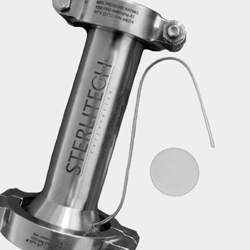
You can see a schematic of the sampling equipment the Institute researchers built in their published study. Their setup involved a submersible water pump that was positioned inside a waterproof case connected to the sampling filter (10 μm hydrophobic polycarbonate membrane filters, along with a 30 μm square mesh nylon filter as a support) which was placed directly in the sea. To protect the filter from wave turbulence they modified one of our filter holders (this one) with a new outlet fitting and a larger, semi-enclosed inlet with a smooth surface. The filters were also placed in protective holders before and after filtration for protection and to reduce the risk of contamination. As an added protective measure, the filter apparatus was ultrasonically cleaned prior to use. The entire sampling apparatus was held 2 meters outside the boat (to further prevent contamination) and the sampling depth was limited to between 0.1 and 1.5 meters to protect it from large waves.

While it will take many more studies before conclusions can be drawn about the state of this particular body of water, the scientists were encouraged by the results of the new methodology they created. They note in the conclusion how these improvements have standardized the sampling and reduced the risk of contamination. The scientists also suggest that this sampling equipment could be adapted for larger particles.

To read the full study, visit here.
^Image from Survey of microscopic anthropogenic particles in Skagerrak. Lysekil and Flødevigen 2010-11-20, Institute of Marine Research.

Friday, June 10, 2011

Silver, Silver Everywhere!

Check out this interesting article from the NIST Tech Beat explaining how nature may be manufacturing silver nanoparticles all by itself. The article also discusses some ideas as to why it is that silver is such a good antibacterial agent.

Read the NIST article here.

Wednesday, June 8, 2011

So Will Chemistry Teachers Have to Order New Posters Now?

Move over Copernicium! A collaboration of scientists from the Lawrence Livermore National Laboratory in California (one of our customers - we're so proud!), and the Joint Institute for Nuclear Research in Russia are being recognized today for officially creating two new elements! Scientists first created these elements in 1999 and 2000, respectively, by slamming lighter atoms together to see if they would stick. After a lengthy experimentation and review process by the International Unions of Pure and Applied Chemistry and Physics they are now certified and ready to take their rightful spots as the heaviest members of the periodic table.

Both of these elements are radioactive and exist for less than a second before decaying into lighter atoms. For now the elements are being referred to by their element numbers, 114 and 116, since the discovers are still in the process of submitting their recommendations.

It's probably a good thing that the naming process is limited only to the researchers that actually discovered the elements. Somehow I think if it was left up to an online poll our kids would be learning the atomic weight of "Bieberum."

Read more about the announcement here or here.

Monday, June 6, 2011

Quenching the Thirst for Potable Water Through Nanotechnology

After our last post discussing how experiments with carbon nanotubes (CNT’s) might greatly improve the effectiveness of reverse osmosis desalination now comes a new report from the Institute of Physics that shows researchers are getting closer to making this a reality. Already over a billion people do not have regular access to clean water and the problem will likely get worse as the demand for drinkable water is expected to grow dramatically in the near future. With natural sources increasingly scarce, this urgent need means there is an intense global interest in any potentially viable forms of water purification.

Right now the main issues preventing RO desalination on a large-scale basis are that the membranes used to perform seawater to freshwater separation do not remove salt ions with enough efficiency and they also require great amounts of energy (and therefore expense) in order to purify the water. Jason Reese, a Professor of Thermodynamics and Fluid Mechanics at the University of Strathclyde and also the author of this report, states, “The holy grail of reverse-osmosis desalination is combining high water-transport rates with efficient salt-ion rejection.” Incredibly, these little carbon nanotubes may be able to satisfy both of these requirements for widespread adoption.

Early tests and simulations have shown that CNT membranes could have water permeability that is 20 times greater than today’s materials. Additionally, carbon nanotubes can be chemically tailored to better reject salt ions, thus improving upon the desalination process in multiple key areas.

While it is still early, these features are promising enough that scientists such as Professor Reese feel it is a very real possibility that this application of nanotechnology could be used to curtail our growing water demand.

Read more about this report here.

Wednesday, June 1, 2011

Enhancing UF Membranes with Carbon Nanotubes

One of the most promising new frontiers in filtration technology involves infusing different membrane types with nanomaterials in order to improve performance or to pass along certain material attributes. Here we will look into one prominent example from recent years, the incorporation of carbon nanotubes (CNTs) into ultrafiltration membranes used in water treatment. We’ll also look at how our stirred cells have aided in this specialized membrane manufacturing process.

First off, what is there to gain by using CNT’s to manufacture water treatment membranes? While scientists have identified several potential advantages for CNT implementation, since the process is still in the R&D phase they have not necessarily been proven in all cases. One key possible benefit is that membranes made with these materials would be much stronger than traditional membranes, thus reducing instances of membrane breakage and fouling, two problems that contribute significantly to high maintenance costs in water treatment. Another unique advantage is that CNTs have antibacterial properties that may reduce biofilm formation and therefore prevent or limit biofouling. Lastly, the process of manufacturing ultrafiltration membranes with CNTs allows the producer to chemically modify the membrane surface which can further reduce fouling by tailoring the membrane for specific organic solutes.

As with standard membrane manufacturing processes, the stirred cell is an ideal piece of equipment for establishing the permeability of the test membranes. For this particular study on the effectiveness of polysulfone ultrafiltration membranes manufactured with CNTs, the cell (an HP4750 in this case) was set to perform dead-end filtration with ultrapure water at 38 bars of pressure (about 551 psi).
The HP4750 Stirred Cell
In order to determine permeability, the HP4750 was directly connected to the pressure regulator of the compressed air tank. Each membrane was compacted at 38 bars until the flow rate was stable (minimum of 30 minutes). Then the flow rate was measured by weighing the permeate as a function of the pressure applied (between 5 and 35 bars). To confirm the results, this test was performed in triplicate.

Permeability is an important test characteristic for determining the membrane’s susceptibility to fouling and its overall efficiency. In the study cited here, researchers found no statistically significant difference in permeability between CNT and non-CNT amended membranes. These findings supported their conclusion that their process for grafting CNTs onto membranes was ineffective. In the conclusion the authors note that because the CNTs only partially dispersed in the host material that they were prevented from taking on the mechanical properties of the CNTs.

While this particular study did not yield the desired results, new methods of integrating nanomaterials onto membranes are constantly being explored and hopefully it’s only a matter of time until these superior membranes become available.

Visit here to read the full study:
http://cohesion.rice.edu/engineering/pedroalvarez/emplibrary/85

Tuesday, May 24, 2011

Rising Salinity Cause for Concern at North Carolina Desalination Plant

An increase in salinity levels at the North Reverse Osmosis Water Plant in Kill Devil Hills (yes, that’s the town name) that had been creating stress for some local officials has been explained in a recent study. Researchers from nearby Duke University found that the rising salinity levels at this coastal aquifer are the result of fossil seawater and not seawater intrusion, as had been feared. Since the well’s installation in the late 1980’s salinity has more than doubled from about 1,000 mg/L to about 2,500 mg/L. There was much cause for relief however, when researchers were able to attribute the rise to fossilized seawater and not to seawater leaking in from the coast.

According to the director of the study, Duke Professor Avner Vengosh, knowing the source of the salinity increase is important because fossil seawater raises salinity, “At a relatively slow and steady rate that is more manageable and sustainable than the rapid increase we’d see if there was modern-day seawater intrusion.” As a result of this study the community will be able to rely on this aquifer for decades to come without having to resort to more expensive seawater desalination techniques which require more energy and advanced filtration methods.

Current treatment for groundwater desalination includes the use of reverse osmosis (RO) membranes to separate dissolved salts from potable water. Even with the rising salinity level these membranes remove around 96 to 99 percent of the dissolved salts. RO membranes also remove between 16 and 42 percent of the boron and 54 to 75 percent of the arsenic from the groundwater. Additional treatment following reverse osmosis desalination continues to remove arsenic until it is within safe drinking levels (10 parts per billion, according to the EPA).

Because seawater consistently has more salt than groundwater it requires more energy to treat, and therefore the cost is higher. Per this report on desalination from the Pacific Institute, “Energy is the single largest variable cost for a desalination plant, varying from one-third to more than one-half the cost of produced water.” The report also states, “At these percentages, a 25% increase in energy cost would increase the cost of produced water by 11% (for RO plants).” In looking at these percentages, it’s easy to see why the plant was concerned about seawater intrusion. Thanks to this research, the local citizens can drink easier knowing they have a supply of healthy, affordable water for a long time to come.

Click here to learn more about this case.

Monday, May 16, 2011

Kids Today

If you haven’t taken a look at the semifinalists for the Google Science Fair you still have a few days left to view the submissions and cast your votes! At stake is a $50,000 scholarship from Google, along with an opportunity to apprentice with Google or one of their partner organizations. There are 60 very interesting entries spread across three categories and covering just about every discipline of science. Suffice to say that the projects went beyond the paper-mache volcano. Some examples include:
Impressive stuff indeed! Especially considering all of these submissions came from 13-18 year-olds, a time when a lot of us were just trying to get a grasp on puberty. Kudos to Google and their partners for this project: CERN, the LEGO Group, National Geographic, and Scientific American. And of course, best of luck to all the entrants! Surely there are some incredibly proud parents, teachers, and mentors behind them.